Showing posts with label art. Show all posts

Tuesday, 29 October 2013

an atrium in the desert


Paul Klee making visible (making im-material)
On at the Tate Modern, London until 9th March 2014


1. 
Hotel rooms. lego blocks 
by a lake. atrium in the desert
at the top of the green fields
the Kasbah folding up into the size of a postage stamp

through a letter box. 
trailing umbilical cord
hushed flaps sail. I can see it all. 


2. traces

at the museum Neue Kunst Hans Goltz
a clockwork mechanism counts down
the silent fishing rod hook beneath the lake
pendulum still, rotations still
tides round the hot lazy sun. 


3. 
tattoos peeling off the sheets
scrolls pressed and dried
toner unfixed
I press through the sheets 
and oil on my palms. 

substance - glass - scales 
shield and reflect 
but the gills let the right ones in


4. 
In the aerodrome hotel a telescope landing strip

the city flattens out. 


5.  etre 
ruined architraves
ancient futures in fish eye memories
the memory of bulbs, from inside out
slicing through the onion epidermis

sandstone's memory, an ocean mountain

this is a concentration game
like a computer game
pinball. architect. dot matrix
woven tear garden


6. 
The cloth makers cottages along Claygate. Three children run to sunday school or out onto the wash. The light curves drawn out onto the open fields. The land here is beneath sea level and so water flows downhill towards the centre. The birds know this and nest. The alphabet's visible root structures. It's the catastrophe of a dream. It's a dot on the map. 


Saturday, 29 January 2011

note to self


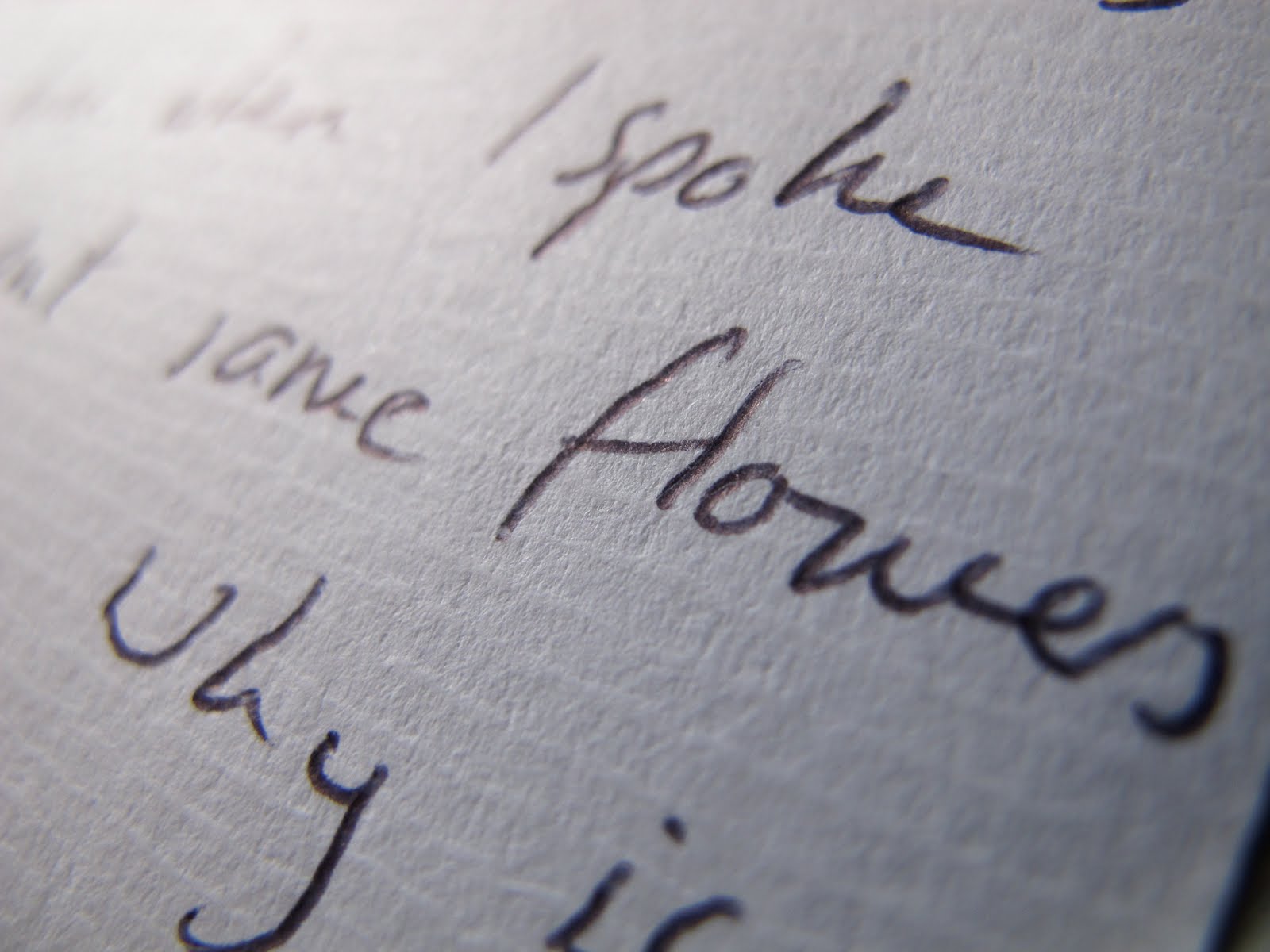
I got a letter from myself this morning. I wrote it in 2006 in the G39 Gallery in Cardiff as part of a work by artist Jennie Savage. I vaguely remember I had gone into the gallery to meet someone and come across the exhibition by chance. I scribbled the letter out as I was waiting for them. I didn't know how long I would be waiting. The letter ended abruptly when the person arrived.

I wrote whatever came to mind in those few minutes. It's a strip of consciousness cut out of five years ago and delivered to me on a cold Saturday, after breakfast. There are two other strangers in the room with me. They seem to be nervous. One is playing with their mobile phone. They look at the exhibit but don't write a letter. I'm aware of them, and a list of other jobs that flit through my memory. Always lists of jobs to do. Flowers. Jobs still at the back of my memory-list five years later.

I photograph the letter this morning: the stamped impression, the fragments of the text. Photographing it makes me start to read down the text in columns rather than in a linear way. It goes like this:


downstairs
he's talking
downstairs
present this


when I go and put some
yesterday. Why
the text


I spoke
some flowers
Why

In the five years since I created the letter I have thought about that afternoon several times and waited for the letter to return. It surprised me this morning. I thought it would be longer coming. 2015, or something like that. I think I liked it more as an im-material memory than a material object sitting on the table in front of me.

Maybe it's time to throw it away.

This is no reflection on piece itself, Savage's work has created a longevity of reflection for this participant, I have returned to the idea time and again to since its creation.

A couple of years ago when I found fifteen-year-old undeveloped rolls of film hidden amongst a drawer of detritus, I realised that here was another time machine waiting to suprise me. I blogged the photos here. Since then I have been occasionally stashing rolls of film about the house to be found and developed at some undecided point in the future.

Note to self: must take some more films and add them to the pile.

For Jenny's reflections on the project look here.

Wednesday, 11 February 2009

Lowlands


I travelled to The Hague and Delft, home of 17th century painter Johannes Vermeer. Vermeer's archetypal image is that of the figure at the window. An interior flooded with cool light. They offer a naturalism pregnant with allegorical possibility.

A girl in servants clothing looks over her shoulder, exposing a pearl earring. The iconic image resides in the Mauritshuis in The Hague, concealing a mystery that rivals the Mona Lisa's smile. It's miniature size and canvas stripped bare of context gives the image the quality of a deftly executed part work. The floating fragment of a unrealised idea.

My travel photos also offer a speculative narrative . I went looking for the quality of Vermeer's light, falling through the curtains, through the blinds. Here are some fragments. I'm putting them together to see if they might suggest a story


images (c) David Foster 2009

Wednesday, 3 September 2008

Summer Lightnings


video stills, Summer Lightnings, 2004, (c) Victor Alimpiev
All images taken from http://www.ekaterina-foundation.ru/eng

Encounters: Victor Alimpiev
Modern Art Oxford

15th June - 31st August 2008

Whose is this Exhalation? The title suggests a whodunit. A group of eight performers bunch together before an evacuated space. They sing: an improvised series of ascending chords. Yet one of the group remains silent, holding their breath and resisting, until their body propels them into a desperate life assuring exhalation. Each phrase of the music climaxes with this release. We watch the group comfort the sufferer whose face moves from agony back to composure. This member of the group will now join the seven singers and another member will gather their reserves to deprive themselves of air. The delicate combination care and suffering within the situation that make the work utterly compelling.

Summer Lightnings takes me back to the class activity of creating a rainstorm by scraping, scratching and knocking on school desks. Here we see a young class performing this same communal effect before the video cuts to the lateral bursts of lightening across cloud burdened skies.

Together the two videos show Alimpiev working with a diverse and intriguing vocabulary consisting of ideas of community, abstract sound, silence, and sinister or powerful natural forces.

I am curious by the idea of silence in both video works. Summer Lightning offers us an audible event that we perceive as silent. We know the violent crack of lightening but disassociate it to the name thunder. Effectively we silence the lightening.

In Whose is this exhalation? Although we are listening to the singers ascending octaves they emerge as a cruel taunt to the silence that forms the vertebrae of each phrase. We watch and listen for silence amongst the sound. Silence is more verbally potent than the prattle of sound in both pieces: it measures and orders the other forces at play.

---
For a short clip of Summer Lightnings go to http://www.videoartworld.com/beta/video_59.html


Video Stills, Whose is this exhalation? , 2008, (c) Victor Alimpiev

Sunday, 29 June 2008

Cy Twombly

Images: Cy Twombly
Text: Cy Twombly with errors, emendations, inclusions, and collaging by David Foster

Cy Twombly , Ferragosto V 1961

*

Please remain behind the line. cross the line. line of trees. line drawn up.
letters wake, shake out the sleep begin to resemble

*

Ferragosto paintings


touching flesh
body tastes
water interludes
U U U days age
131415


globes
fruit juices
wanton sky
feria lights
ache
crusted


hardly a
noun all
summer
touching
big sex
huge cunt
fruits
almost waking
lift my head


Cy Twombly, (Untitled) Bolsena 1961

Bolsena Series

cloud 9. sun. bulb. 335. 3 1/2. 1 67. 144. 17 ½ . 2. by 2 by 3. number II. CT. 67. 2. 3. 7 ½ . 92. void (3) (3) w. w. w. bulb. sum.

38. 2 ½ . 4. just. 1 ½ . 7 – 11. 3 ½ . brushing. orbits. 124. 200. 126 – 700. 180.214. overlay. clearing 14 O E. 12662870. error 0 3 x.

sssssssswch. ssssssssssswch. 2/8. 2 over 1 2 2 stage 2 4. 1964. raise vertical. N028. ½ . 3 4 2. 4 < 4/5. 1801. 224. 14x20. 18x20 lay. stem and out


*

Veil Paintings


shuttle. rails. convey.

sheets along the plain

one moment also proceeds

conveyance purring trail. chalk grates

mail pouring. commute

inside the falling veil.


*

Untitled 1971


roomful and not even . so

rain . rain from the east

rain through the day. rain at dusk.


Cy Twombly, The Wilder Shores of Love 1985

Shores


grid bubbles sur-wake
as if glass mirrors. the surface of the
scatter. In the hall. rain leaks
pigment. braile. sur-wake. drowns
breathing. tow gondolas through the. rake sifting
channel dredge up. notes scatter. window
blows open.


Cy Twombly, Quattro Stagioni: Primavera
1993-5


Quattro Stagioni


1. And you who thought of happiness fleeing would feel the
illumination that almost overwhelms and will.
motes suture happiness pulling little falls

2. goodbye cumulus. high on light and white youth. forever touching it melts and faints. goodbye Catullus. you made me realise.

3. Autumn sweet breads. passenger, you’re Priam B.S.E.E.M.S you beetroot fog.
and yet in the south and exceeding moon like


*
Cy Twombly, Cycles and Seasons
At the Tate Modern , London
19th June - 14th September, 2008
http://www.tate.org.uk/modern/

Here’s an introduction to Twombly’s work
http://www.tate.org.uk/tateetc/issue13/cytwombly.htm

Sunday, 1 June 2008

Bucharest Biennale: In-Between Cities


Sabine Réthoré, Lovely Romania, 2008, color print, 135x135 cm. Courtesy the artist. A map of Romania turned on an East - West axis.


Bucharest Biennale

Various venues
23rd May - 21st June 2008
www.bucharestbiennale.org
Information Point: Sos. Nicolae Titulescu nr. 1 (Piata Victoriei)

Entering the Unibank Pavilion at the Bucharest Bienniale I am greeted not by the smooth interior of a commercial gallery space but by a series of gutted rooms. Walls are stripped to bare brick work and electricity cords hang down from the ceiling. The space has just been given to the biennale organisation group, a signal that Bucharest is beginning to emerge as a commercial location for art. Speaking to Ravzan Ion, Biennale director, I comment that I like the sense that this gallery is an in-between space. He responds: ‘It’s an in-between city.’

It is suitable then that the subject of the Biennale should be mapping and cartography. A theme devised by the Biennale curators Jan Erik – Ludström and Johan Sjöström. It’s a theme made very real to me as foreigner who has not visited Bucharest before. Like any tourist I am consistently gazing at walls to look non-existent street signs, trying to figure out the tangle of bus routes or looking for conference rooms that doormen and receptionists have no knowledge of. It’s impossible to create a map of an in-between space; the map will almost immediately be outdated.

Books, posters, documents, websites all find a place in the materials on exhibition across the city. This both adds variety and suggests that curation was dictated by what was available.

My impression is that the work roughly divides into artists either approaching mapping in a personal, speculative manner or in a research led 'objective' approach. For the first group there are maps in rugs, maps made from food or distortions and reshaping of maps. Lukas Einsele’s extensive One Step Beyond project would be a good example of the second approach.

In One Step Beyond Einsele has documented the experiences of civilian victims of landmines in a number of war torn countries. Photographs and testimonies of victims are placed next to personal maps that eloquently describe the arbitrary geography of their tragedies. Lukas has also created his own map of Angolan capital Luanda from his memories. He described the map as full of mistakes where he had forgotten details. The work combines to make an engaging illustration of the fallibility of mapping in a location where uncertainty is always there in the ground beneath one’s feet.


Lukas Einsele, One Step Beyond, texts images and multimedia formats 2005. Courtesy of the artist. An illustration by 12 year old Angolan landmine victim Rebecca Mujinga. The picture illustrates where she stood on a VS50 anti-personnel mine.


The Biennale director Razvan Ion tells me that the Unibank gallery will endeavour to be a research led space, commenting that the people of Bucharest need to be involved in the art to be exhibited in the gallery. The scene in the city is clearly at a stage where it needs to build an audience and develop debate. It will be interesting to see if the city and its artists can use the generic moment and the weight of a troubled history to produce engaging work and new propositions.

Links:
Lukas Einsele: One step Beyond, The Mine Revisited