Showing posts with label image. Show all posts

Friday, 7 November 2014

Syndics of the Drapers' Guild (1662)


Rembrandt paints the moment the deal is struck. The drapers syndics cast their critical idea over the Rembrandt's materials. 

We're not sure about any of these ideas Mr van Rijn. Do you have anything else? 

You don't like that? Well, then, just as you are, right now. That's fine. Like that. Like you are.

And the best thing is that he persuades them. So the Syndics cast their critical eye on us. Measure us up - it's a negotiation - no-one must be sold short. 

Tuesday, 29 October 2013

an atrium in the desert


Paul Klee making visible (making im-material)
On at the Tate Modern, London until 9th March 2014


1. 
Hotel rooms. lego blocks 
by a lake. atrium in the desert
at the top of the green fields
the Kasbah folding up into the size of a postage stamp

through a letter box. 
trailing umbilical cord
hushed flaps sail. I can see it all. 


2. traces

at the museum Neue Kunst Hans Goltz
a clockwork mechanism counts down
the silent fishing rod hook beneath the lake
pendulum still, rotations still
tides round the hot lazy sun. 


3. 
tattoos peeling off the sheets
scrolls pressed and dried
toner unfixed
I press through the sheets 
and oil on my palms. 

substance - glass - scales 
shield and reflect 
but the gills let the right ones in


4. 
In the aerodrome hotel a telescope landing strip

the city flattens out. 


5.  etre 
ruined architraves
ancient futures in fish eye memories
the memory of bulbs, from inside out
slicing through the onion epidermis

sandstone's memory, an ocean mountain

this is a concentration game
like a computer game
pinball. architect. dot matrix
woven tear garden


6. 
The cloth makers cottages along Claygate. Three children run to sunday school or out onto the wash. The light curves drawn out onto the open fields. The land here is beneath sea level and so water flows downhill towards the centre. The birds know this and nest. The alphabet's visible root structures. It's the catastrophe of a dream. It's a dot on the map. 


Sunday, 13 November 2011

The Wilderness of Stories


An Illustration by Jim Kay, from the novel A Monster Calls. Written by Patrick Ness from the ideas of Siobhan Dowd.

The novel tells the story of Conor, a school boy and his mother who is suffering from terminal cancer. The novel is accompanied by utterly beautiful illustrations. I felt they concentrated the pain and emotions of the story in a completely graphic way.

There are further illustrations, by Jim Kay from the book here


Saturday, 29 January 2011

note to self


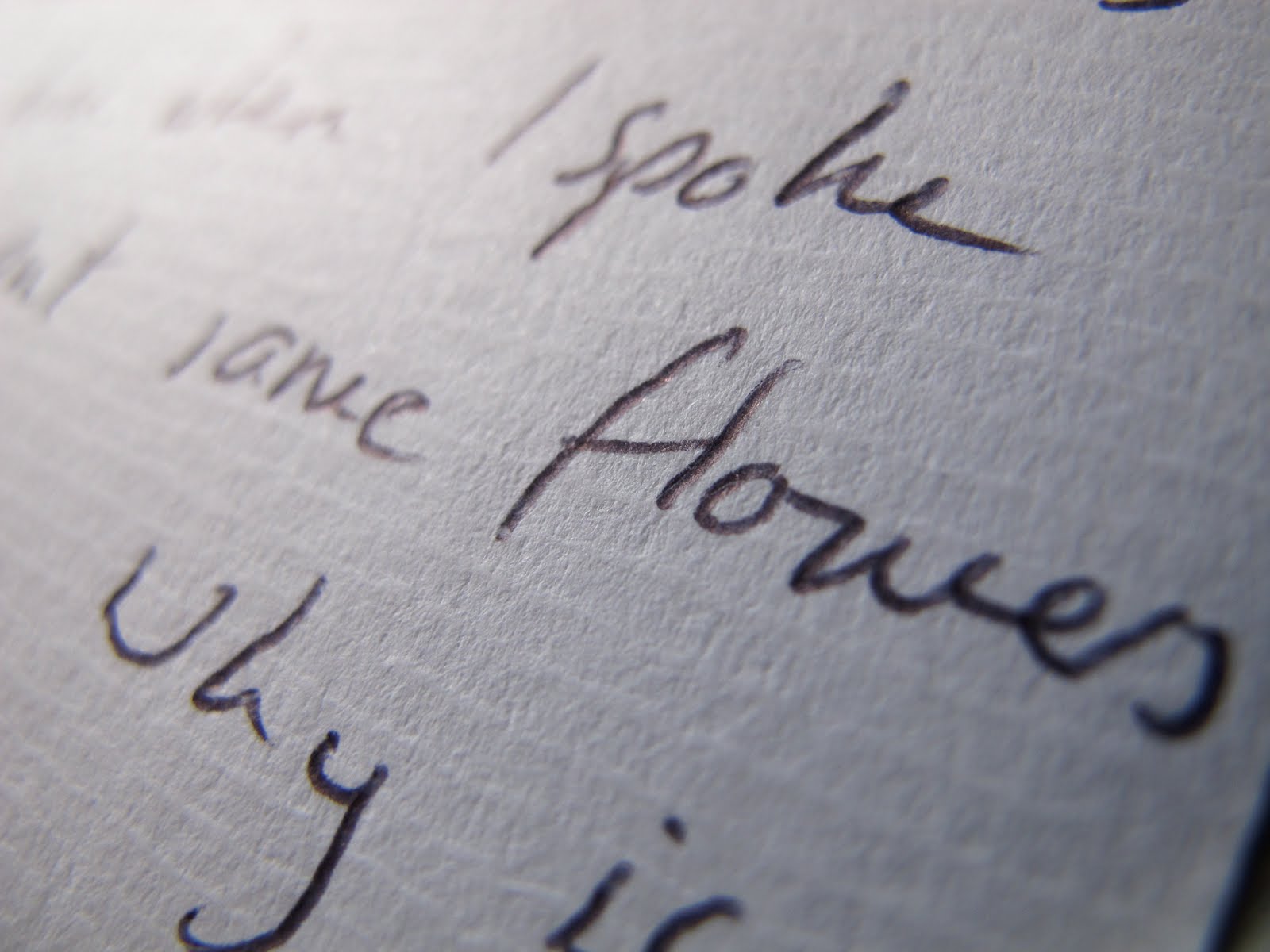
I got a letter from myself this morning. I wrote it in 2006 in the G39 Gallery in Cardiff as part of a work by artist Jennie Savage. I vaguely remember I had gone into the gallery to meet someone and come across the exhibition by chance. I scribbled the letter out as I was waiting for them. I didn't know how long I would be waiting. The letter ended abruptly when the person arrived.

I wrote whatever came to mind in those few minutes. It's a strip of consciousness cut out of five years ago and delivered to me on a cold Saturday, after breakfast. There are two other strangers in the room with me. They seem to be nervous. One is playing with their mobile phone. They look at the exhibit but don't write a letter. I'm aware of them, and a list of other jobs that flit through my memory. Always lists of jobs to do. Flowers. Jobs still at the back of my memory-list five years later.

I photograph the letter this morning: the stamped impression, the fragments of the text. Photographing it makes me start to read down the text in columns rather than in a linear way. It goes like this:


downstairs
he's talking
downstairs
present this


when I go and put some
yesterday. Why
the text


I spoke
some flowers
Why

In the five years since I created the letter I have thought about that afternoon several times and waited for the letter to return. It surprised me this morning. I thought it would be longer coming. 2015, or something like that. I think I liked it more as an im-material memory than a material object sitting on the table in front of me.

Maybe it's time to throw it away.

This is no reflection on piece itself, Savage's work has created a longevity of reflection for this participant, I have returned to the idea time and again to since its creation.

A couple of years ago when I found fifteen-year-old undeveloped rolls of film hidden amongst a drawer of detritus, I realised that here was another time machine waiting to suprise me. I blogged the photos here. Since then I have been occasionally stashing rolls of film about the house to be found and developed at some undecided point in the future.

Note to self: must take some more films and add them to the pile.

For Jenny's reflections on the project look here.

Friday, 21 January 2011

Calle


The character of a city can always be seen in the style of street signs. London signs them in monotonous block capitals embossed on iron. Madrid on tiles with beautiful images recalling the name. Bogota street signs have the drama and romance of magical realism. Letters dance across the stone. Sloping tails of letters sweep into their neighbours. Letters merge with each other to create ideograms. I wanted to stop on every street corner.

dsc


my first digital camera, shortly to be made redundant.

Tuesday, 18 January 2011

jardin


I love signs in the sky.

Friday, 18 June 2010

no more football related posts... ever.

numbers from the people


Umbro's 'Tailored in England': Instead of spending millions on a campaign showing David Beckham shooting an Ewok (or something) why not show the glory of Beckton, Bow, Wortley or Wallsend. You can kinda see why England's best players have come from these places... Basically there was fuck all else to do but play football in the car park or down the recky.

http://www.umbro.com/englandwalls/


Good luck lads for tonight. I'm hoping for a semi-final, at least.


Umbro's campaign also reminds me of Lee Friedlander's excellent 'Letters from the People'. A symphony of unbound phonemes.


Saturday, 12 June 2010

library


I've been working in a library which has the rare luxury of too much space. The result is that endless volumes of journals sit on the shelves instead of being hidden away in the stack below.
Presumably many of these will never be read again.
So this is my elegy for all these hours of study.


(C) David Foster 2010

Saturday, 29 May 2010

photocopier malfunctions


syllabus


technique

(c) David Foster 2010

Friday, 9 April 2010

Sunday, 4 April 2010

Science and Industry


(C) David Foster 2010

screen grab


(C) David Foster 2010

Everything until the memory ran out.

Thursday, 19 November 2009


Nights are drawing in.

Friday, 31 July 2009

screen grab


(c) David Foster 2009

Monday, 23 March 2009

Gerhard Richter: Portraits


Gerhard Richter: Portraits
National Gallery, London
27 February - 31st May 2009

Razor sharp focus. It’s a prerequisite of the photography industry. The images that surround us offer the eye the illusion of every detail. For this reason viewing Gerhard Richter’s Portraits at the National Portrait Gallery challenges the eye.

The hallmark of Richter’s portraits are paintings that subordinate the photographic image for very different ends. The canvases offer the shapes of figures which on closer inspection break up into flat layers of paint. Richter’s most striking technique, which is in evidence throughout this retrospective, is to rake a brush across the damp canvas smudging the tones together. The result gives an appearance of automatism to his images; As if they had been produced by a period photocopier or printer. These surfaces are Richter’s tool to inhibit the viewer’s attempt at interpretation. From a photograph we expect a copy of reality. However, here the viewer is required to consider a number of visual contradictions: paintings that appear to be photos, figures that remain illusive, canvases that have the appearance of mass produced objects.

The exhibition contains further illuminating contrasts in Richter’s work. The atrium of the gallery is filled with Richter’s monumental 48 Portraits a work which dryly offers us a canon of great white males looking down on the viewer. Take the elevator to the upper galleries and you rise up through the ranks. However, the prevalent subject matter here is not the iconic image but the family portrait. This is an object that he describes as a modern ‘devotional picture.’ With these images Richter offers the viewer a chance to glimpse into personal relationships while emphasizing their conceal realities. Richter portrays his daughters in a way that both captures personality and side steps it by hiding the subject’s face of using an unusual angle. In a small self-portrait Richter appears to be emerging from deep inside the picture. Coming into focus, but looking away from the camera as if to resist its gaze.

The final surprise is Richter’s installation of a mirror in the gallery as the exhibition’s final work. Richter compares the mirror to one of his paintings, suggesting that it offers a semblance of the thing without showing us the object itself. Seeing oneself staring into the mirror with the traffic of the gallery behind offers exactly this experience. It reminds me of Velasquez’s Las Meninas; suddenly we’re
Wednesday, 11 February 2009

Lowlands


I travelled to The Hague and Delft, home of 17th century painter Johannes Vermeer. Vermeer's archetypal image is that of the figure at the window. An interior flooded with cool light. They offer a naturalism pregnant with allegorical possibility.

A girl in servants clothing looks over her shoulder, exposing a pearl earring. The iconic image resides in the Mauritshuis in The Hague, concealing a mystery that rivals the Mona Lisa's smile. It's miniature size and canvas stripped bare of context gives the image the quality of a deftly executed part work. The floating fragment of a unrealised idea.

My travel photos also offer a speculative narrative . I went looking for the quality of Vermeer's light, falling through the curtains, through the blinds. Here are some fragments. I'm putting them together to see if they might suggest a story


images (c) David Foster 2009